
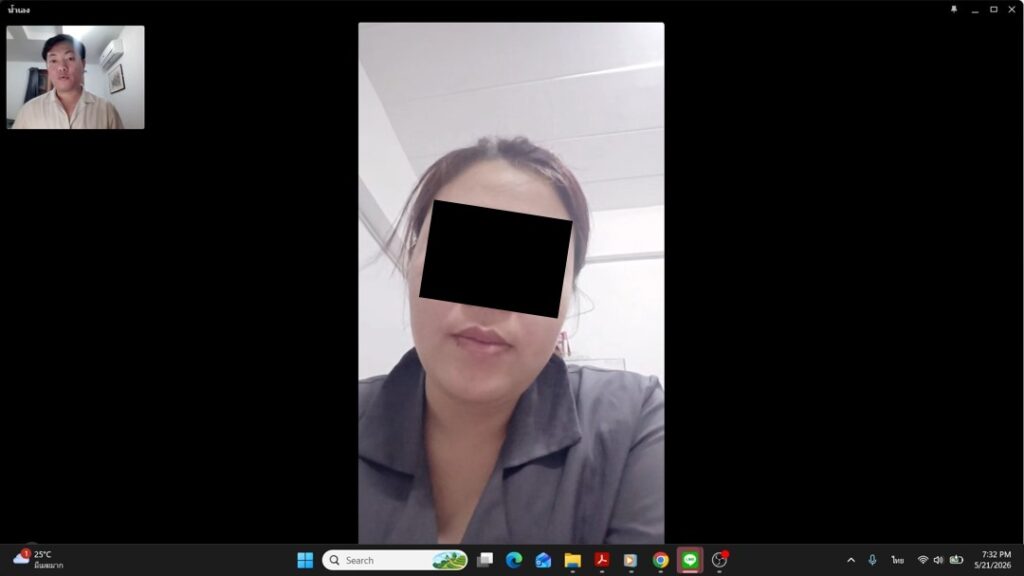
On 21 May 2026, Kwah Dao Foundation was contacted by A (pseudonym), a person experiencing problems concerning civil registration and nationality status, who sought legal advice under the Foundation’s Legal Assistance Program. The details of the case are as follows.
Family Background
1. Father and Mother
A’s parents migrated from Shan State, Myanmar, and entered Thailand around 1997. Since then, they have lived and worked in a district in Mae Hong Son Province, where they continue to reside today. Before entering Thailand, neither of them had ever been registered or issued an identity card by the registration authorities in their country of origin.
After arriving in Thailand and beginning to live and work here, they needed to register in order to work legally. Their employer therefore took them to register as migrant workers. Subsequently, when a survey was conducted to register persons without civil registration status and issue them identification cards, commonly known as “10-year cards,” issue for stateless persons. Both parents applied to be included in the survey, as did many others. Their information was recorded, and they received documentary evidence of their registration. Unfortunately, they later encountered a problem involving duplicate civil registration records because they had previously registered as migrant workers. As they had received little formal education and had no knowledge of the law, they did not know that they needed to explain the circumstances and submit relevant evidence establishing the origins of the duplicate records. Consequently, their registration records were deleted, and they could no longer use their 10-year cards.
Furthermore, because they did not know that an administrative order deleting their registration records had to be challenged within the time limit prescribed by law, they lost the opportunity to contest the order. As a result, they lost access to healthcare benefits, the right to apply for permission to travel outside their designated restricted area to work in other provinces or for other purposes, and the opportunity to apply for permanent residence in Thailand.
Based on the factual information obtained from A, it was established that her parents had only registered as migrant workers several decades ago. They had never obtained a Certificate of Identity (C.I.) issue by Myanmar Nationality Verification Office in Thailand, and had never possessed civil registration documents from their country of origin. They were therefore considered stateless and without nationality.
Kwah Dao consequently advised them of two possible courses of action:
-
- Apply for reinstatement of the deleted registration records. They could submit an application to the civil registration office where their registration records had originally been created. They would need to prove that they were stateless persons who had entered and resided in Thailand by 30 September 1999 and had actually been living in an area covered by the registration survey at that time. They would also need three credible witnesses to corroborate their statements. If the authorities determined that they met the applicable eligibility criteria, their registration records could be reinstated, allowing them to subsequently apply for permanent residence in Thailand; or
- Apply for identification cards for persons without civil registration status (Stateless Person ID Card) under Section 38, paragraph two, of the Civil Registration Act. If the facts established that they did not belong to the target group described in the first option, they could instead apply for such identification cards. At a minimum, obtaining these cards would allow them to reside temporarily and lawfully in Thailand while awaiting further development of their civil registration status following possible legislative amendments in the future.
A’s parents have four children. Their first child has already been surveyed and issued an identification card for a person without civil registration status (a 10-year card). Their third child has completed an associate degree and is currently undergoing the process of obtaining a 10-year card, as they had never registered as a migrant worker. Their fourth child was born in Thailand and therefore does not face problems concerning civil registration status. A, the second child, is the only one currently experiencing such problems.
2. A’s Personal Background and Current Circumstances
A was born in Shan State, Myanmar, and entered Thailand in late November 2006. However, she started formal education later than usual because she had to care for her youngest sibling, who has a visual impairment. A completed upper secondary education through the Non-Formal and Informal Education (NFE) system in a district in Mae Hong Son Province. While studying, she also had to work to support herself and her family.
Although she was determined to pursue higher education, she encountered obstacles because she did not possess the identification card required by educational institutions. Several institutions refused to accept her application, while others informed her that she could enroll but would not be issued an academic certificate upon graduation. Consequently, A has been unable to continue her education as intended unless she first resolves her civil registration status problem.
A has never held an identification card. She only remembers that her parents’ employer once took her to register as a dependent of migrant workers. This appears to have been the origin of her civil registration status problem. The district officials considered the evidence of her registration as a dependent and, on that basis, applied a presumption that she already possessed a nationality.
A has lived in Chiang Mai Province for approximately ten years and currently works as a hotel housekeeper, earning approximately THB 9,700 per month. Her partner works at a car rental shop and earns approximately THB 12,000 per month. Despite their relatively modest combined income, A is responsible for all her own living expenses and helps support her younger brother and send money to her family in Mae Hong Son Province. She also bears responsibility for caring for her younger brother, who has a visual impairment, including covering his medical expenses. Consequently, her monthly income is barely sufficient to cover her expenses, and she must live from month to month.
3. Previous Attempts to Resolve Her Civil Registration Status Problem
Before seeking legal advice from Kwah Dao, A had attempted several times to apply for an identification card for a person without civil registration status (a 10-year card). However, the officials did not process her applications and instead advised her to register as a migrant worker and obtain a Certificate of Identity (C.I.), explaining that this would be a simpler course of action. A did not wish to pursue this alternative because she was concerned that it would entail ongoing expenses. Furthermore, she believed that she was entitled to apply to be surveyed and registered for a 10-year card. She therefore did not want to choose an alternative that might cause her to lose the opportunity to exercise the rights to which she believed she was entitled.
Legal Assistance Provided by Kwah Dao
After reviewing the facts, the Kwah Dao determined that A did not fall within the target group of school and university students who were studying and residing in Chiang Mai Province. In addition, A and her partner had reasonable employment income, and Kwah Dao Foundation had not allocated a budget to provide assistance in cases of this nature. Consequently, Kwah Dao was unable to act as her legal representative or pursue claims on her behalf.
Nevertheless, Kwah Dao provided detailed legal advice, explaining the relevant laws and the procedures available at each stage. This included gathering facts and supporting evidence, identifying potential witnesses and assessing their credibility, submitting applications, responding to situations in which officials refused to accept applications or caused unreasonable delays, providing statements and information to officials, following up on applications, challenging administrative orders, and bringing a case before the Administrative Court if necessary.
A understood the limitations on the assistance that Kwah Dao Foundation could provide and learned about the available procedures. She intended to attempt to pursue the matter independently by following the recommended steps.
Follow-up and Further Guidance
During the most recent follow-up, it was found that A had once again contacted the district office to submit an application, but her application was again rejected. A appeared increasingly discouraged by the obstacles she continued to face.
Kwah Dao therefore encouraged her to persevere a little longer. This was because the Bureau of Registration Administration had recently revised its guidelines for individuals who had previously registered as migrant workers or obtained a Certificate of Identity (C.I.). Under the revised guidelines, individuals who had received a letter from the embassy of their country of origin refusing to certify their nationality were eligible to apply for an identification card for a person without civil registration status, Stateless Person ID Card.
Kwah Dao also advised A on how to contact the embassy of her country of origin to obtain such a letter, which could be submitted as supporting evidence for her future application.

