
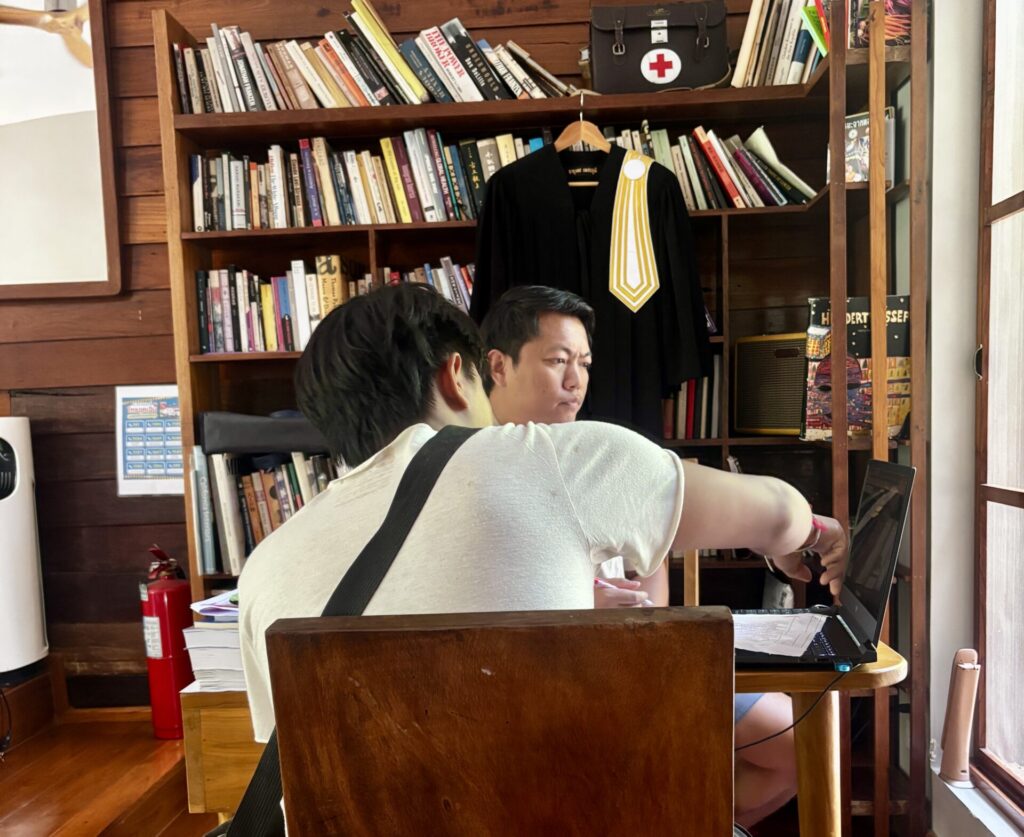
On May 23, 2026, Kwah Dao Foundation provided legal assistance to a migrant worker from Myanmar, referred to by the pseudonym Sai, who had been involved in a motorcycle accident. The accident left him with a fracture in his ankle and caused minor damage to his motorcycle. Concerned that he might not be treated fairly by the police, Sai sought assistance from Kwah Dao Foundation, which provided strategic advice on negotiating with the disputing party and presenting a detailed account of the incident to the police.
The accident occurred the previous night, at approximately 10:00 p.m., while Sai was riding his motorcycle home from a relative’s residence. He was traveling along Road 1006 in San Kamphaeng District toward Chiang Mai city when a pickup truck suddenly signaled and turned left into a side street, cutting directly across his path. Sai was unable to stop in time and collided with the side of the pickup truck. Both vehicles sustained damage, and Sai fell onto the sidewalk, fracturing his ankle.
The pickup truck driver attempted to blame Sai, alleging that he had been speeding and riding carelessly. Sai, however, maintained that the other driver had suddenly turned into the side street and cut him off. When the other party’s insurance representative arrived at the scene, the representative appeared to insist that Sai was at fault and that he should compensate the pickup truck owner for the damage. This occurred before the police had arrived to inspect the scene, question both parties, or determine the extent to which either party was responsible for the accident.
Kwah Dao Foundation therefore conducted a detailed fact-finding assessment, examining both parties’ driving behavior, speed, traffic conditions, and state of awareness, as well as the available evidence. The assessment indicated that both parties had been negligent and contributed to the accident; the pickup truck appeared to bear a greater degree of responsibility. Sai is entitled to claim compensation in proportion to the other party’s share of responsibility. If the other party refused to pay, Sai could bring the matter before a court. In that case, he would need to present evidence demonstrating why the other party was more negligent than he was and how the claimed damages had been calculated.
Kwah Dao Foundation identified two key legal risks that Sai needed to consider.
- Ownership of the Motorcycle and Driving License Issues
Although Sai’s older sister had given him the motorcycle involved in the accident, the vehicle registration had not yet been transferred to his name. If Sai provided inaccurate information during police questioning, his sister could also face criminal liability. Under Thailand’s Motor Vehicle Act, a vehicle owner is prohibited from allowing an unlicensed person to drive their vehicle. The Act’s definition of a vehicle includes motorcycles, and violations may result in imprisonment or a fine for both the vehicle owner and the driver.
Furthermore, because this legal provision is intended to protect public safety, Thai civil law presumes that a person who violates it has committed a wrongful act and is therefore liable for damages.
Kwah Dao Foundation explained to Sai and his sister that, since the motorcycle had already been given to Sai, he was its owner even though the registration had not yet been transferred. Accordingly, he should accurately inform the police that he was the motorcycle’s owner.
- Driving Behavior Before and at the Time of the Accident
The accident occurred at night. Although Sai’s exact speed was unknown, and it had not been established whether he had exceeded the speed limit for that road, his driving behavior was another important legal consideration. As Sai was moving forward on the left side of the road while the pickup truck suddenly turned left, the police might interpret his maneuver as overtaking on the left, which is prohibited under the circumstances and could constitute a violation of Thailand’s road traffic laws.
Sai explained that he had believed the pickup truck was going to turn right because the driver had initially signaled a right turn before suddenly turning left. If this was indeed what had happened, Sai’s maneuver will not be considered illegal overtaking on the left.
Kwah Dao Foundation therefore emphasized that Sai needed to explain this point clearly to the police, maintaining that he had not overtaken the pickup truck on the left and providing the reasons and circumstances that had led him to proceed as he did.
To help ensure that Sai could give an accurate and consistent account to the police without unnecessarily compromising his legal position, Kwah Dao Foundation conducted mock police questioning sessions with him. These rehearsals helped him anticipate the kinds of questions he might face and understand how to explain the circumstances without being held solely responsible for the accident. If Sai were found solely at fault, the other party’s insurance company could exercise its right of subrogation and seek reimbursement from him for the costs of repairing the pickup truck.
After several rounds of practice, Kwah Dao Foundation was satisfied that Sai was prepared to meet with the police and the other party and then provided Sai and his sister with documentary evidence to support his account of the incident. It also strongly advised him not to sign any document prepared by either the police or the other party if it stated or implied that he alone was responsible for the accident, or that both parties were at fault but Sai alone would be required to pay the damages. Instead, he was instructed to seek further advice from the Kwah Dao before signing anything so that it could recommend an appropriate course of action.
One week later, Kwah Dao followed up with Sai and learned that the outcome had unfolded as anticipated during the mock questioning sessions. The police had questioned both parties and carefully considered their respective accounts before concluding that both had been negligent. They instructed each party to repair their own vehicle, after which both parties were allowed to go their separate ways.
Sai was satisfied with this outcome and decided not to pursue any compensation from the other party. The matter was therefore resolved without further claims.

